
In Plain English: Why does soap cure? Fresh soap isn't finished soap.
A freshly cut bar of soap is a lovely thing to look at. The colours are vivid, the pattern is crisp and the scent is strong, so you'd happily wrap it straight away and send it out into the world. Instead, we put it on a shelf and leave it alone for several weeks.
Not because we've forgotten about it. With soap made by the cold process, curing is still part of production. A bar can look finished long before it has the properties of finished soap.
And although nothing seems to be happening on the shelf, quite a lot has already happened inside – and there's more to come.
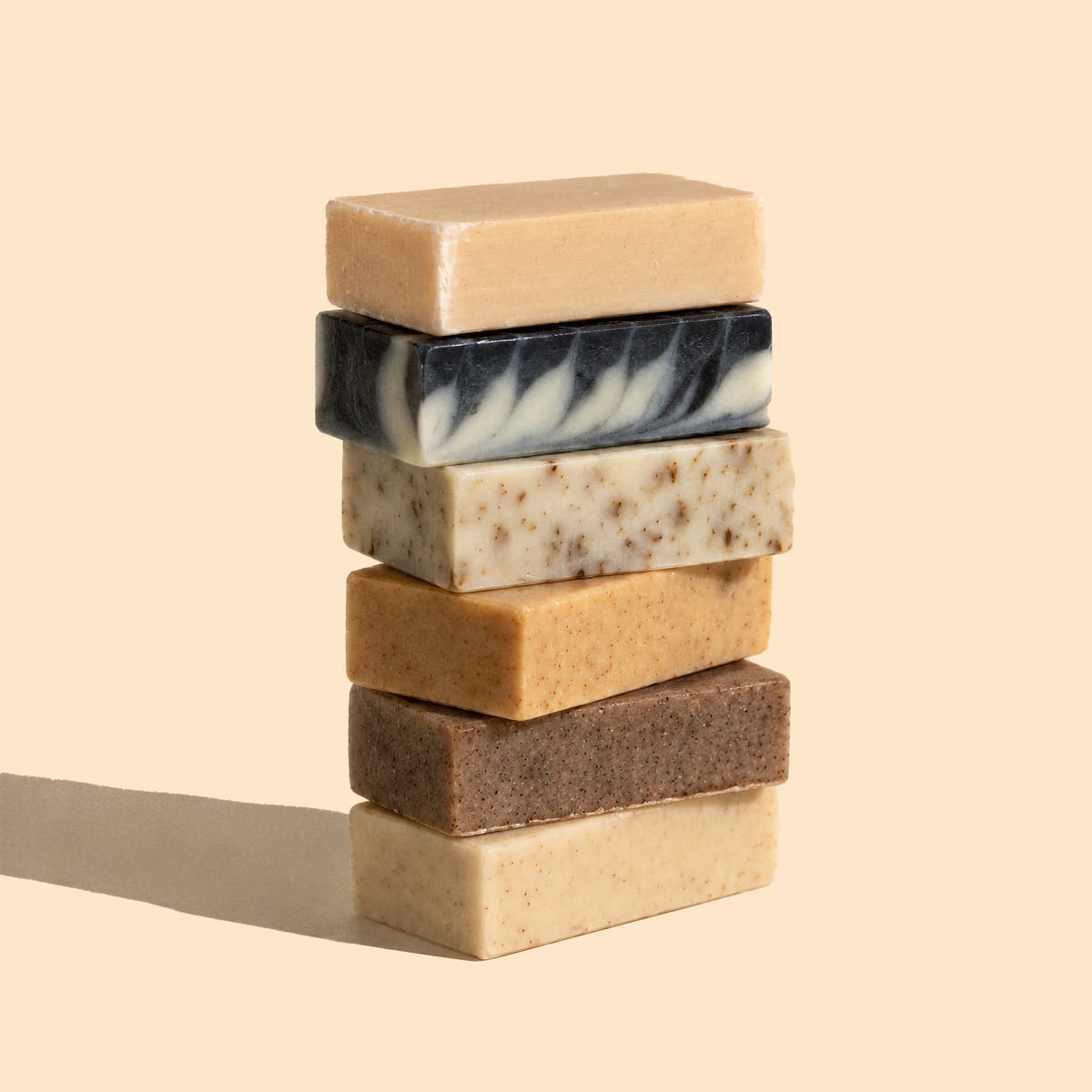
First the mould, then the shelf.
In cold-process soap making, we combine oils and fats with a sodium hydroxide solution. Saponification begins – the chemical reaction that produces soap salts and glycerine. The soap mass gradually thickens, is poured into a mould and left to set.
But that's not the end of the process. Saponification is an exothermic reaction, which means it gives off heat, and the soap mass in the mould can warm up enough to go through what's known as the gel phase. It temporarily softens, turns more translucent and can take on a gel-like consistency. The centre of the block usually gets the hottest, and the heat spreads from there towards the edges.
The gel phase isn't a requirement for making cold-process soap, but it can affect how the finished soap looks. Soaps that go through it fully often have richer colours. If, on the other hand, the centre heats up much more than the edges, you can get a partial gel, which sometimes shows up after cutting as a darker patch in the middle of the bar.
That's one reason why the recipe, the temperature of the ingredients, the batch size, the mould and the conditions in the room all matter. Just because we've poured the soap mass into the mould and stopped stirring doesn't mean the process is over.
Once the block has set firmly enough, we take it out of the mould and cut it by hand. At that point the individual pieces already look like the soaps you'll eventually take home.
They're just not ready to go home yet.
What curing actually means.
Saponification is still finishing off in the first few days after production, but most of it happens fairly quickly. So soap doesn't cure for several weeks simply so that “the lye can disappear”.
Saponification and curing are two different things. If you're curious about the reaction between the oils and the hydroxide itself, we've covered it in more detail in the article In Plain English: What is saponification and what role does it play in making soap?
During the curing that follows, what mostly happens is far less dramatic but very important for the finished bar: the soap gradually loses water.
We need water in production mainly to make the sodium hydroxide solution, and freshly cut soap still contains quite a lot of it. When we place the individual bars on shelves with enough air around them, the water slowly evaporates, the soap loses weight and hardens.
If we weighed one bar regularly while it cured, we'd see the difference on the scales too. At first the weight drops more noticeably; later the loss slows down.
And this is where the waiting starts to show at the washbasin. Fresh soap with a higher water content is softer, turns mushy more easily and can get used up faster. A cured bar is harder and more stable and, stored properly between uses, it lasts longer.
So no, the soap on the shelf isn't just waiting for its box. It's still becoming a better version of the bar we cut.
A bad recipe doesn't turn good with time. It just gets older.
What about pH?
Curing is often associated with the idea that soap has to sit for several weeks so that its “pH can balance out” and it stops being alkaline. That's not quite accurate.
True soap is alkaline by its very chemical nature, and curing won't turn it into a pH-neutral product. Saponification finishes during the first few days and the system settles, but the main point of the following weeks of curing lies mostly in the gradual loss of water and the changes to the soap's physical properties and how it performs in use.
The same goes for the claim that curing automatically makes soap milder. The properties of the finished bar are determined above all by the recipe – the choice and ratio of oils, a correctly calculated amount of hydroxide, the amount of water and the whole way the soap is made. Curing lets a well-designed recipe reach the properties it's meant to have, but it won't fix a poor one.
How do we know soap is cured?
When nothing dramatic seems to happen to a bar for weeks on end, the obvious question is how we actually know it's ready to go from the shelf into its box.
There's no single miracle test and no single number. What we look at is a combination of how production went, time and the properties of the particular batch.
The foundation is a well-built recipe and a saponification that ran as it should. During curing, you can then track the weight loss caused by water evaporating, the hardness of the bar and how it behaves in use. The longer soap cures, the more slowly its weight changes, and its properties gradually stabilise.
Experience with a particular recipe plays a big part too. If you make the same soap again and again, you know how it behaves after a week, after a month and later still, and you can tell whether a new batch is developing the way it should.
So we don't check curing by looking at the date. We check the soap.
Why at least 30 days?
Because there's no single universal day that applies to every cold-process soap. How quickly water is lost depends on the recipe, the amount of water used, the size and shape of the bar, but also on the temperature, humidity and air circulation during curing.
Some recipes need more time than others. A typical example is soaps with a very high proportion of olive oil, which can benefit considerably from a longer cure in terms of hardness and how they perform in use.
That's why at MuSK we've set a minimum of 30 days from production. Not because something miraculous happens in the soap on day thirty, but because that's our minimum production threshold. If a particular recipe or batch needs more time, it stays on the shelf longer.
It's also why production has to be planned several weeks ahead. When a soap sells out, we can make the next batch straight away, but we can't wrap it and sell it straight away too. It has to go through the same process as the one before.
With cold-process soap, time simply can't be ordered by express delivery.
Fresh soap isn't finished soap.
So when we put freshly cut soap on the shelf, a large part of production is already behind us. The oils and hydroxide have gone through saponification, the soap mass may have gone through the gel phase in the mould, the block has set and we've cut it into individual bars by hand. But there's still water that has to leave gradually, and the bar needs time to harden and gain the properties we expect from finished soap.
That's why we leave our soaps to cure for at least 30 days, and longer depending on the recipe. Only then do they get their packaging and move on.
There's nothing magical about curing. It's just one of those parts of the craft where the hardest thing is to do nothing extra and let the process finish its work.
To lather is human. Letting soap cure is a craft.

To lather is human. So is subscribing.
New recipes, myths from the soapery and market dates. We only write when we have something to say.